In-house recruiters running volume
One role, two hundred applicants, and a first round that realistically reaches thirty of them. Everyone gets the interview; you get a ranked shortlist instead of a resume pile.
AI first-round interviewer
Kestrel runs the whole first round — application, resume verification, a 30-minute two-way interview, and a ranked shortlist your hiring manager can read in five minutes.
Built for in-house recruiters, HR teams without a recruiting function, and hiring managers who need a first round that holds up to being questioned.
No facial analysis
Nothing about a face enters a score.
Every score is quoted
Each one cites the transcript line behind it.
No automated rejections
A named person clicks decline, with a reason.
Who it is for
Most of what makes it hard is not the work — it is who interviewed well, who reminded you of someone, who you spoke to last. This takes the emotion out of the first round and puts the best fit for the role in front of you, with the evidence for it attached.
One role, two hundred applicants, and a first round that realistically reaches thirty of them. Everyone gets the interview; you get a ranked shortlist instead of a resume pile.
You own hiring on top of payroll, benefits and everything else. This runs the first round end to end and hands you a scorecard a hiring manager can read in five minutes.
Interviewing well is a skill that decays between openings. The competencies, the follow-ups and the anchors are the same for every candidate, so the comparison holds up.
Agencies, regulated employers, and teams hiring into New York or Illinois. Disclosure, consent, quoted evidence and an audit log for every access come as standard.
One role, everyone who applied
Every candidate, what they scored, which channel they chose, and what still needs a person. Filter it, save the view, export it, or send two to eight of them to the comparison.
How it works
The numbering is the sequence a candidate actually moves through, from the application to the moment a person on your team makes the call.
Branded page or embeddable widget. The resume is parsed on upload; gaps, overlaps and inflated titles are flagged for the interviewer to probe, never used to reject.
Voice in the browser, a phone call, WhatsApp, or text chat, in English. No account, no app, and no timer punishing someone who thinks before answering.
25 to 40 minutes: resume walk-through with verification, STAR deep-dives with adaptive follow-ups, role scenarios, and consistency checks woven in. Each score cites the line it came from.
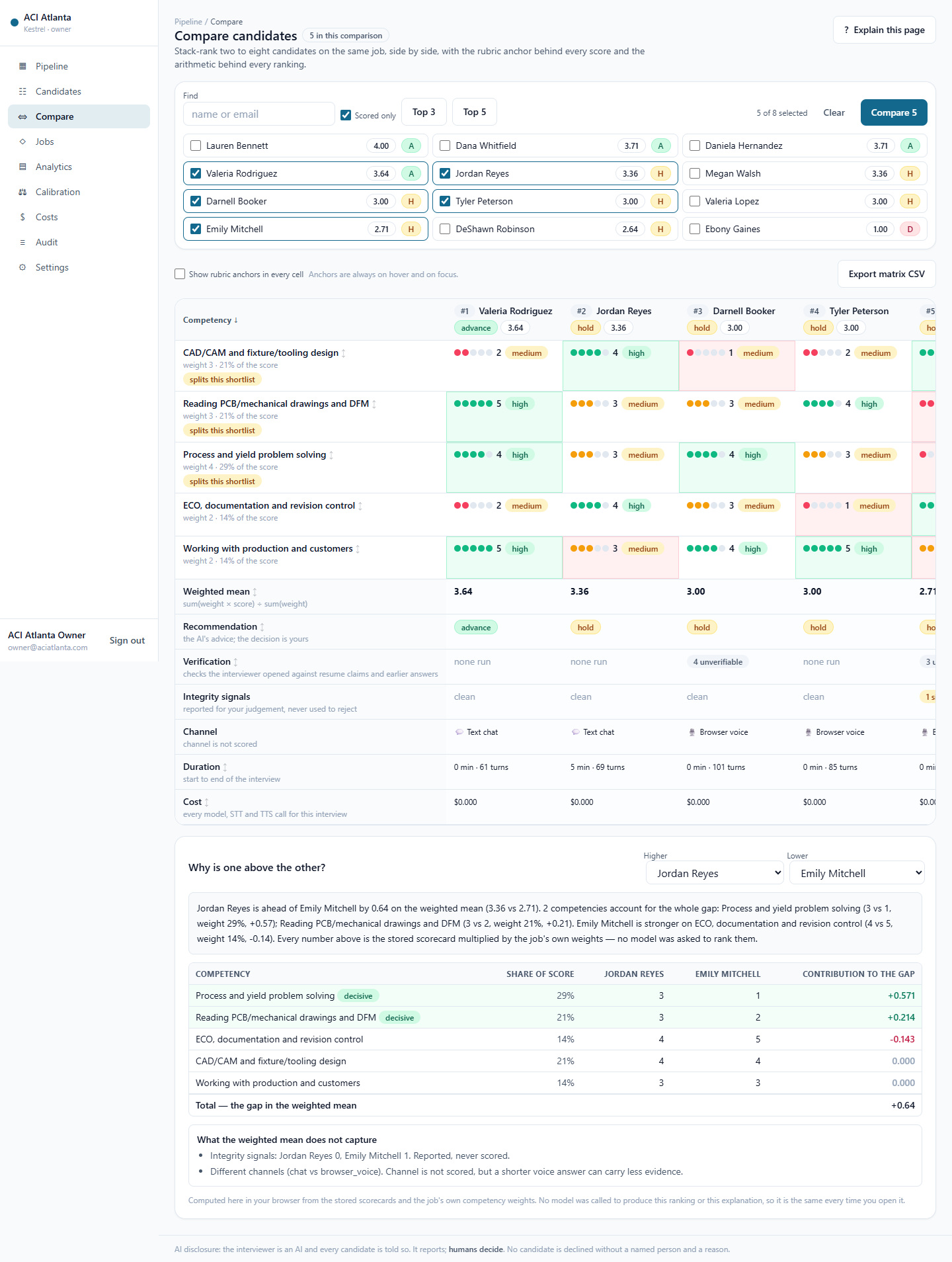
Stack-rank the shortlist, read the arithmetic behind any ranking, and advance or decline. Nobody is declined without a person clicking decline.
Why it matters
2×more predictive
Structured interviews predict job performance about twice as well as unstructured ones — validity .42 against .19.
Why every candidate gets the same competencies, the same rubric and the same anchors.
Source: Sackett et al. (2022) meta-analysis; Schmidt & Hunter (1998) found .51 against .38
60%never finish applying
Three in five workers have started a job application and abandoned it before submitting.
Why the interview starts immediately, in the browser, with no account and no app.
Source: iCIMS, 2025 State of Frontline Hiring Report
$4,129average cost per hire
The most-cited industry benchmark for what a single hire costs in direct recruiting spend alone.
Why the first round is worth doing properly rather than screening on a resume scan.
Source: SHRM Human Capital Benchmarking Report, fiscal year 2015 — dated, and almost certainly higher now
$1,500a day, per violation
New York City fines employers who use an automated hiring tool without an annual bias audit or candidate notice — and counts every single day the tool is used as a separate violation.
Why disclosure, consent and an audit log are built in rather than bolted on.
Source: NYC DCWP, Local Law 144 ($500 first violation, $500-$1,500 thereafter). Illinois AIVIA separately requires consent before AI video interviews.
What this will never do
Most AI interviewing tools score a candidate on how they look and sound. That is the part regulators are closing in on, and the part that is hardest to defend when someone asks why they were rejected.
No video scoring, no micro-expressions, no gaze tracking. Nothing about a face enters a score.
An accent, a stammer or a flat affect cannot move a number. Where an answer is delivered unlike the same candidate's other answers, that prompts one more question and never a score.
No five-factor profile, no culture-fit index, no proxy for traits nobody agreed to be measured on.
Pre-send classifier · example
Blocked before it was asked
“Do you have kids at home who might make the weekend shifts difficult?”
Asked instead
“This role needs two weekends a month on site. Does that work for you?”
The candidate never hears the blocked draft, and the block is written to the audit log.
Calibration
Score a handful of transcripts yourself and see where the model and your team disagree, competency by competency. A rubric nobody has checked is just a number with a label on it.
Live demo
These careers pages are real and run the full interview. Apply with any name and interview by voice in your browser, by phone at +1 877 467 3541, or by chat.
Electronics manufacturing · Duluth, GA · English
Engineering Support / Junior Manufacturing Engineer — CAD, DFM, yield investigations, and a reflow-failure scenario.
1 open role
Destination weddings · Cancun / Riviera Maya · Remote
Coordinator, content creator, product engineer and part-time sales — resort negotiation, content-ownership verification, shipping judgement and closing couples.
4 open roles
Compliance